Sunday, November 13, 2022

Orthodox Objectivism's Struggle with the Inheritability of Intelligence

[Introductory Note: the following is an important article by ARCHNBlog contributor Neil Parille. One thing to bear in mind in relation to the subject of intelligence is that the correlation between measured intelligence (i.e., IQ) and societal outcome success is one of the highest correlations ever measured by social science. The persisting skepticism of intelligence in orthodox Objectivist circles constitutes, as Neil explains in this essay, the legacy of Rand's blank slatism.]

One thing I’ve noticed over the years is that Objectivists are, like apparently a fair percentage of the population, skeptical of intelligence tests (which I’ll call IQ tests).  A while ago I heard Ayn Rand Institute president Yaron Brook claim that IQ tests are “B.S.” (he didn’t use the abbreviation). Perhaps less surprising is that Objectivists are generally skeptical of the contention that intelligence is a highly heritable (put colloquially, genetic) trait.

As I’ve mentioned before, there is quite a disconnect between what psychologists know about intelligence and what the average person believes.  Here is what probably close to 100% of experts in the field of intelligence research believe:

1. There is such a thing as intelligence.  Some people are better at math, have a bigger vocabulary and are better at solving problems of all kinds.

2. IQ tests reliably measure what we consider intelligence.

3. Intelligence is a highly heritable trait, probably in the 50 to 80% range.*

4. IQ correlates to a variety of life outcomes.  Higher IQ people on average commit less crime, have less illegitimacy, have lower rates of drug use, etc.

If you don’t believe me, here are three prominent left wing intelligence researchers.

Here is Rand’s definition of intelligence:

“Intelligence is the ability to deal with a broad range of abstractions. Whatever a child’s natural endowment, the use of intelligence is an acquired skill. It has to be acquired by a child’s own effort and automatized by his own mind, but adults can help or hinder him in this crucial process.”

It is occasionally said by Objectivists and others that there are kinds of intelligence or aspects of intelligence that aren’t captured or measured by IQ tests.  This idea was made popular by Harvard University’s Howard Gardner in his book Multiple Intelligences.  Gardner listed among other types of purported intelligence musical ability and athletic ability.  Most would consider these things skills.  In any event, this dubious theory doesn’t undercut the consensus view of intelligence.  For example, if you consider playing baseball a form of intelligence, it is still the case that given two equally gifted baseball players the one with the higher IQ will tend to be a better player.  Put differently, nothing has been identified as a form of intelligence which inversely correlates to IQ.

Leonard Peikoff was asked in 2016 what Ayn Rand’s IQ might have been.  He responded that he didn’t have any idea because IQ was not a topic in the Objectivist community during Rand’s life.  He said that he didn’t know whether IQ tests were valid.  I recall, but can’t find the podcast, where Peikoff was asked if Rand believed intelligence had a genetic basis.  His response was that Rand didn’t think it mattered because we don’t use all of our brain power (or words to that effect).  This is a common claim but, if one thinks about it, is untrue.  If someone has an accident and loses twenty percent of his cognitive functioning, he is unlikely to increase his mental ability to his pre-injury level by more effort.

It does seem that Objectivists who are informed on these issues accept the consensus.  Edwin Locke is a prominent Objectivist psychologist and an expert in the field of motivational psychology.  In his 2017 book, The Illusion of Determinism, he accepts that intelligence is genetic in the 50 to 80% range. He sees egalitarianism behind the multiple intelligences theory, e.g., “we are all equally smart, just in different ways.”  In his 2020 Objectivist Conference talk he discussed IQ tests and accepted their validity.  Harry Binswanger said in a couple podcasts that he thinks IQ tests measure intelligence and intelligence is at least moderately heritable.

I imagine that many Objectivists have a hard time accepting the high heritability of intelligence for a few reasons: 

First, it conflicts with their blank slate view of human nature.*  As Rand famously said, man is a “being of self-made soul.”  In her essay “Racism,” Rand defined racism as “the notion that a man’s intellectual and characterological traits are produced and transmitted by his internal body chemistry.”  Taken to the extreme this means that every person is born with the potential to be a Newton since Newton’s genius must have been unrelated to his “body chemistry.”  (But note that in her definition of intelligence Rand referenced a child’s natural endowment.)   Yet if intelligence is highly heritable then nature places a limit on human ability.  The average IQ is 100.  It takes an IQ of 115 to be an accountant and an IQ of 130 to be a Ph.D. research scientist.  It follows then that the average person will not be able to become an accountant and the average accountant won’t be able to become a physicist. 

Second, an additional reason is the correlation between intelligence and desirable life outcomes.  Put differently, people with an average IQ of 110 will have an easier time navigating the difficulties of life than people with an average IQ of 90.  Some people are just born to be more successful than others. Although high IQ people can make a mess of their life, the Bernie Madoffs of the world are the exception.

Third, Objectivists, like Rand, contend that achievement is largely a question of proper epistemology.  In Introduction to Objectivist Epistemology, Rand considered the world’s problems to be largely caused by an inability to solve “the problem of universals” (which she considered to be synonymous with a theory of concept formation).   I’d rather have a good theory of concept formation than a bad one, but there is no evidence to believe that Objectivists develop scientific breakthroughs at a higher rate than others.

Fourth, if intelligence is highly heritable, then what about other traits such as political beliefs, personal honesty or industriousness?  Evidence shows that there is at least a moderate genetic component to these as acknowledged by up and coming  Objectivist psychologist Gena Gorlin.

_______________________

*This is established by studies of identical twins separated at birth and adopted into families with different socio-economic status.  The IQ of an adopted child correlates to the IQ of the biological parents than the adopting parents.  

**I’ve heard Objectivists say that Rand’s view of man being a blank slate is limited to the rejection of innate knowledge and isn’t necessarily related to the nature/nurture debate.  On the other hand, I’ve corresponded with at least a couple prominent Objectivists who claim that males are not innately more aggressive than females notwithstanding that this is observed everywhere and persists even when attempts are made to raise boys and girls equally.  See James Q. Wilson’s Crime and Human Nature.

Sunday, October 16, 2022

Objectivist Roundup, October 2022

Not much happening in the world of Objectivism in the last month or two.

The only thing of note is Carl Barney’s response the ARI’s strange piece on schisms.  Barney makes several good points and it’s also interesting to see his version of the events that led to his break with the ARI.  Some money quotes:

My break with Yaron (and it was fundamentally with Yaron rather than with ARI) came about when I was giving him about $4 million a year and he wanted more. I said I would give him more, but I wanted to know his strategy for ARI and Objectivism. After painfully frustrating and failed strategic planning meetings, Yaron, in order to persuade me to continue funding ARI, agreed to promote and deliver Leonard’s courses. This was really important to me. But he didn’t keep his word....

My efforts regarding the dispute resolution process go back to 2015. I said to Yaron and some ARI Board members, “I have a lot of money invested in the success of ARI. Another disruptive conflict, such as the McCaskey affair, could severely damage ARI and my investment as the McCaskey affair did. So, would you agree to a dispute resolution process to head off any further disputes?"

Yaron agreed and said he would make it happen. (This was a condition of my giving him more money.) Over the next few years, I met with two lawyers who were also involved with ARI, Steve Simpson and Larry Salzman (Larry was on ARI’s Board). We met for many hours, attempting to draft a process that would be approved by Yaron. The lawyers and I met, discussed details, drafted versions, critiqued them, and edited them over and over. But ultimately, Yaron and Onkar would not approve them. I tried and tried, for about four years, working with Steve, Larry, Yaron, and others to establish a dispute resolution process. I spent probably between 100 and 200 hours. But nothing came of it.

One might cynically point out that the most rational people on earth shouldn’t need a highfalutin conflict resolution process, but $4 million a year is a lot of money.  And if Brook is half as arrogant and condescending in private as he is in public, I can’t blame Barney.

Tuesday, September 27, 2022

An Epistemological Quandry

Harry Binswanger has come out with a video on Ayn Rand's break-up with philosopher John Hospers. Binswanger attended the notorious meeting for the American Society for Aesthetics that led Rand to terminate her friendship with Hospers. Against the advice of his colleagues, Hospers had invited Rand to present a paper on aesthetics. Rand read one of her essays on her concept of a "sense of life." Afterwards, Hospers offered some criticisms of Rand's theories, to which Rand then offered a replied. 

Now according to Binswanger, Hospers criticism was "unhelpful," amounting to something of a philosophical put-down. "He didn't give her respect," he would later recall. When Rand delivered her responses, she was "so nice and so gentle." But when she looked in Hospers direction, to perhaps gauge his reaction, he not even paying any attention to her.

Hospers delivers a remarkable different account of the event:

By tradition, commentators make criticisms. Mine, I thought, were mild as criticisms go. I wondered publicly about whether every work of art (even mediocre ones) carries with it a sense of life; I mentioned Ayn’s own example of Dinesen (fine writing, but an awful sense of life); I speculated about whether to any extent what we say about sense of life depends on the language we use to characterize it ("emotive meaning" again).

I saw something wrong when I noticed that her remarks in response were icy, sarcastic, even insulting. I never discovered what there was about my remarks that made her "go ballistic." Apparently I had betrayed her, and I had done so publicly, when an academic audience already presumed critical of her might have been turned her way. There was no doubt that she felt deeply hurt. At the party in her room afterward, she would not speak to me, nor would anyone else: word had gone out that I was to be "shunned." I never saw her again.


So the epistemological question that confronts us is How can we know which account is the right one? Presumably, almost everyone who participated and witnessed the event in question is dead. A few members of the audience who, like Binswanger, were mere students may still be around. But finding them would be difficult and verifying that they were actually in attendance at the meeting close to impossible. So it really is Binswanger's word versus that of Hospers (who is no longer with us). How are we to determine which, if either, is telling the truth? Does Rand's own epistemology provide us any insights on solving this quandry?

Sunday, September 25, 2022

Review of Simon Lemieux's Book on Rand

Who the Hell is Ayn Rand? was recently published.  It is written by Simon Lemieux who teaches at Portsmouth Grammar School in England. It’s a volume in a new series of brief introductions to ancient and contemporary thinkers. It’s a good overview of Rand’s life and philosophy from a somewhat left-wing perspective.  In particular, I like how Lemieux lets Rand speak for herself, letting the reader judge for himself if Rand’s ideas are correct or practical.  In this respect it’s quite unique in the world of Randian criticism.  In lieu of a formal book review, I’ll summarize each chapter and make some comments.

Introduction

The introduction points out that Ayn Rand continues to be controversial.  Lemieux also notes that Rand has been misrepresented and “wasn’t a fully-fledged libertarian or a reckless libertine.”  He makes the interesting observation that Randianism is something of a combination of Nietzscheanism and can-do American individualism.

Wednesday, September 07, 2022

Objectivist Round-up, September 2022

1. Who the Hell is Ayn Rand? was recently published by Simon Lemieux. It’s a volume in a new series that provides brief introductions to ancient and contemporary thinkers. It’s a good overview of Rand’s life and philosophy from a somewhat left-wing perspective. I hope to review it in a week or two.

2. Ayn Rand Fan Club interviewed Michael Stuart Kelly of the Objectivist Living website. I enjoyed the discussion of his friendship with Barbara Branden, his involvement in The PARC Wars, and the rise and fall of Objectivist forums.

3. Chris Sciabarra just announced that the final issue of The Journal of Ayn Rand Studies will come out in 2023. JARS published numerous significant articles on Rand and related issues. Chris also published two important essays on Rand’s college transcripts based on archival research. I will always be grateful to Chris for printing three book reviews I wrote. JARS was first published in 1999.

Sunday, July 31, 2022

Objectivist Round-up, August 2022

1. An expanded version of the Letters of Ayn Rand is now online. According to Jennifer Burns, this is one of the few pieces of Rand’s posthumous material that hasn’t been rewritten to any significant extent. When I read the volume years ago, I thought that the correspondence to John Hospers was particularly interesting. To print those parts of Rand’s letters that quote Hospers’ correspondence with her, the editor needed Hospers’ permission. They agreed to print Hospers’ statement:

“The letters were interstices between oral conversations; they were written only when Ayn and I were at different geographical locations and could not meet in person. Almost all of the significant material in our communications with each other was in oral, not written, form. The letters may thus give a distorted view of the content of our conversations.”

"You rightly have a great interest in reproducing everything that Ayn said; and you have no particular interest in whatever it was that I said, either to initiate a discussion or to respond to her. The result is that my thoughts just don’t appear in these pages—not that you wanted them to, of course. But sometimes I thought that Ayn had not correctly apprehended a point I had made, and her summary of what I said sometimes did not reproduce what I really did say. Whether what I said was mistaken or not is beside the point here; I was often more interested in clarifying a point than in presenting it for acceptance. I am afraid the reader who read what Ayn wrote to me, and not what I wrote to her, would gather that I was a bloody fool. I daresay that in some ways I was, yet not so much as one would get the impression of from the letters. The trouble is, from her letters one gets only one side of a dialogue. And that isn’t quite fair, is it?”

2. The Ayn Rand University has a new course on comparing Rand’s ethics to the “virtue ethics” of Philippa Foot and G. E. M. Anscombe. I wonder what Rand would have thought about this kind of compare/contrast approach to her work. Anyway, while the course seems a bit expensive at $1,200, you can aways audit it for a mere $900.

3. Speaking of compare/contrast, Harry Binswanger has an interesting video discussion comparing Rand’s philosophy to “academic philosophies.” See here, here and here. Harry says he hasn’t followed academic philosophy since 1990 but he’s been told that philosophy has gotten better since then. He mentions John Searle and Phillipa Foot. Searle’s Mind, Language, and Society is a good introduction to philosophy that sounds like Rand at times. Foot’s best known work is Natural Goodness.

4. The Atlas Society has a You Tube channel with many interviews.

Sunday, July 03, 2022

Objectivist Roundup, July 2022

1. Once it became likely that the United States Supreme Court would overturn Roe v. Wade, it’s been all abortion all the time for the Ayn Rand Institute. They have even published a free Kindle book, Why the Right to Abortion is Sacrosanct, not knowing apparently that the “primary dictionary definition” of sacrosanct is, “most sacred or holy.”

2. Speaking of abortion, it’s not clear what Rand’s views were. The ARI’s claim that she supported legalized abortion until birth is debatable. See here and here.

3. This is an interesting (and unusual) discussion with a critic of Objectivism by the Ayn Rand Centre UK. I had never heard of Paul Crider before, but as an Objectivist turned libertarian turned conventional left winger, his criticisms of Objectivism and Atlas Shrugged are much more informed than most critics.

4. Speaking of Objectivists turned liberals, Dr. Diana Hsieh took her website down stating that it no longer reflects her current beliefs. Based on her Twitter feed it seems that she is more or less a left winger. She actually has become a union organizer. I don’t know of any studies, but most Objectivists who leave the movement seem to turn libertarian or conservative.

Friday, June 24, 2022

Guessing Game

Now let's test our ability to match a quote with the appropriate Objectivist (or Objectivist approved) philosopher. Among the great apostles of reason, which great thinker penned or spoke the following bit of rhetoric in praise of enlightenment, independent thinking, and intellectual courage? The quote is as follows:

Enlightenment is man’s release from his self-incurred tutelage. Tutelage is man’s inability to make use of his understanding without direction from another . . . "Dare to think! Have the courage to use your own reason!" is therefore the motto of the Enlightenment.

Who must we thank for this bit of eloquent magniloquence on behalf of "reason"? Is it Rand? Is it Peikoff? Is it perhaps Binswanger? Or is it some other Objectivist-sympathizing worthy? Can anyone guess this without cheating?

Thursday, June 16, 2022

Objectivist Roundup, June 2022

Here's another roundup of latest Objectivist news, compliments of Neil Parille:

1.  Spanish philosopher Luca Moratal Romeu has a 415 page book on Ayn Rand’s political philosophy.  The book is $37.  I can read Spanish but, unfortunately, there is no Amazon preview so I don’t think I’ll be purchasing it.

2.  ARI philosophers Onkar Ghate and Mike Mazza discuss criticisms of Ayn Rand by professional philosophers Sidney Hook and Robert Nozick.  I can’t find Hook’s review of For the New Intellectual on the web, but my recollection was that much of his criticism was focused on Rand’s caricature of the history of philosophy in the book’s introductory essay.

3. OCON 2022 kicks off next month.  Some of the talks look interesting, but when I saw that future Rand biographer Shoshana Milgram was speaking, I checked the speaker’s section.  Apparently, she is still working on her biography, which will only go to 1957.  I wonder if the book will ever be published.  If so, it likely won’t be authorized as previously promised.


Sunday, May 08, 2022

Objectivist Roundup, May 2022


1. A Companion to Ayn Rand (2018) is now out in a more reasonably priced paperback edition. Although all the contributors are associated with the ARI, the essays are in general valuable, albeit not particularly critical. What I found most interesting is that Greg Salmieri acknowledged that the editing of Rand’s posthumously published writings (such as her Journals and Question and Answers) leaves something to be desired.

2. The ARI’s recent “Of Schisms” essays has received criticism from two of its targets, Robert Tracisnki and Craig Biddle They challenge the essay’s description of their schisms.

Thursday, March 31, 2022

Objectivist Schisms: an Overview by Neil Parille

As observers of Objectivism know, schisms are a perennial part of the world of Objectivism. In particular, the “official Objectivism” going back to Ayn Rand, which has continued into today with the Ayn Rand Institute (ARI), has been particularly prone to dust-ups, breaks, and even excommunications.  I don’t know of any sociological studies of schisms that might shed light on this, but there may be a couple reasons.  First, Objectivism is a relatively small movement, and most people tend to know each other.  This means that disputes will tend to become personal.  Second, many associates of Ayn Rand are still alive.  Hence protecting her legacy in their eyes likely heightens the gravity of any disputes.
 

The biggest schism in the Objectivist movement was Ayn Rand’s break in 1968 with Nathaniel and Barbara Branden.  The Brandens were the chief promoters of Objectivism, particularly through the Nathaniel Branden Institute.  While the details remain somewhat obscure, the rupture began because Nathaniel and Rand had years earlier commenced an affair which eventually grew cold.  When Rand wanted to restart the affair, the much younger Branden balked at this, in large part because he was having an affair with a beautiful young model and actress, which he concealed from Rand for years.  When Rand found out about his affair, she denounced Nathaniel in her own inimitable way.  In her “To Whom It May Concern Statement,” she never mentioned that she and Branden had an affair, nor Branden’s clandestine affair with the model.  She went on to denounce him for failing to devote his efforts to advance Objectivism and she all but accused him of stealing from her. She did hint that Nathaniel had betrayed her in an unspecified way:


This year, in a long series of discussions, held at his request to help him solve what he characterized as his psycho-epistemological problems, I was shocked to discover that he was consistently failing to apply to his own personal life and conduct, not only the fundamental philosophical principles of Objectivism, but also the psychological principles he himself had enunciated and had written and lectured about. For example: he was unable or unwilling to identify the motivation of some of his actions or the nature of his long-range goals; he admitted that in many respects he was acting on the basis of unidentified feelings.


As Nathaniel later wrote in his memoir, Rand’s attack was so “over the top” that people suspected that he was an alcoholic or a child molester.  Both Nathaniel and Barbara responded, countering Rand’s allegations of wrongdoing.  Nathaniel hinted that there had been an affair and conceded that he concealed something important of Rand.  He explicitly denied her allegations of financial wrongdoing.
After the Branden split, there were other schisms during Rand’s life.  After her death, Leonard Peikoff, Rand’s self-proclaimed “intellectual heir,” started the ARI.  Peikoff shortly thereafter split with philosopher David Kelley over Kelley’s contention that Objectivism was an “open system.”  Peikoff’s denunciation, in which he purported to speak for Rand, was vitriolic.  More splits, generally of a lesser significance, have continue until the present.

Monday, March 07, 2022

Taking Ideas Seriously

[Neil Parille continues where he left off in 2009.]

Ayn Rand was quite explicit that ideas are what matter and, in particular, it’s abstract philosophical ideas which guide human history.  Because of this, Objectivists usually blame the sorry state of the world on “intellectuals” and professors of philosophy.  Leonard Peikoff once said that we’d know the world is on the right track when the philosophy department of UC Berkeley was Objectivist.

Objectivists talk about the history of philosophy as a battle between Plato and Aristotle.  According to Objectivists, a society or culture succeeds to the extent it adopts Aristotelian ideas.  For example, they argue that the Renaissance began and flourished because Thomas Aquinas supposedly reintroduced Aristotle’s works to the West.  In the main Objectivist work of historiography, Peikoff’s The Ominous Parallels, he argued that Nazism and the gas chambers were the direct result of the influence of Immanuel Kant on German intellectual life.  Christianity, to them, is as foolish as one can get.

History paints on a large canvas.  One can find examples and counterexamples to prove or disprove any broad historical narrative.  For example, contrary to Rand, many scholars argue that the most important Renaissance thinkers were Platonists.  Germany’s leading Kantian philosopher was Ernst Cassirer.  It’s said that upon hearing a Nazi say “truth is what the Fuhrer says it is,” he responded, “if that’s the case, there is no hope for Germany.”  He promptly left for England.  I recently heard Yaron Brook claim that the Roman Empire fell because it adopted Christianity.  Yet the Eastern half of the Empire - which was more Christian – lasted until 1453.

Monday, January 24, 2022

Objectivism on Christianity and Religion

[Here is another article  by Neil Parille:]

Ayn Rand and her followers have a bee in their bonnet when it comes to religion. In particular, contemporary Objectivists often fret about the influence on the Religious Right on politics. It doesn’t appear, however, that they have spent much time studying the topic of religion because the same old chestnuts keep popping up again and again..

Sunday, January 16, 2022

The PARC Wars Revisited

[ARCHNBlog is privileged to have the following contribution by Neil Parille, who discusses some the latest information to surface concerning James Valliant and his book The Passion of Ayn Rand's Critics.]


As long-time readers of the Ayn Rand Contra Human Nature blog might remember, one of the strangest incidents in the recent history of the Objectivist movement was the publication in 2005 of The Passion of Ayn Rand’s Critics (PARC) by James Valliant.  This book took aim at Barbara Branden’s 1986 biography of Ayn Rand, The Passion of Ayn Rand and Nathaniel Branden’s two memoirs.  It is also noteworthy for including Rand’s diaries from the time of her break with Nathaniel Branden.  These diaries were provided to Valliant by Rand’s heir, Leonard Peikoff.

Wednesday, December 29, 2021

ARI on Vaccines and the Pandemic

Susan Hanson has published an article in The American Thinker attacking ARI's views on the Covid-19 pandemic. While she makes a few good points in her little screed, on the whole I'm not convinced she's being altogether fair. She seems to be upset, for example, that Onkar Ghate, ARI’s Chief Philosophy Officer, believes that government has a role in fighting pandemics. Of course, what that role is can be very difficult for any Objectivist or Libertarian to explain, given their basic political orientation. And while Ghate's attempt to outline an Objectivist policy toward infectious disease is by no means beyond criticism, I didn't really find anything within it that is all that objectionable. Perhaps he could be criticized for being far too pragmatic in his willingness to compromise with the present system; but on the flip side, what choice does he have? It's not as if he can snap his fingers and make all the government controls that Randians find objectionable to just go away. On the big issues relating to freedom, he seems to be on the side of freedom, opposing both the lockdowns and the vaccine mandates. 

Monday, August 23, 2021

How I Became a Critic of Objectivism 4

Rand's epistemology constitutes the most intimidating part of the Objectivist philosophy. Introduction to Objectivist Epistemology is a difficult book, even for Objectivists. By the time Ayn Rand wrote it, she had already secured herself in an echo chamber from which no criticism could ever reach her. IOTE was accepted by her disciples as a gospel that could not be questioned. But how much of the theory does the typical Objectivist actually understood or care about? Other than a few Rand nerds, I don't think most Objectivists give a fig for IOTE. They may be pleased it exists, allegedly serving as a base for Rand's ethics and the politics. But they could care less about the largely technical issues raised in IOTE.

Critics have often ignored Rand's epistemology as well. The fact is, it's Rand's ethics and politics that stirs up the animals on both sides, pro and con. Those critics that have tried to analyze the Objectivist epistemology have either gotten lost in the thickets or have become consumed by purely technical issues that most people don't care about. For me, Rand's epistemology could be reduced to two salient points: a denial (or at least mis-characterization) of the unconscious, intuitive phases of human thought; and the insistence that every word has an "objectively correct" definition. Those are the most important, or at least the most relevant, points of Rand's epistemology. By importance I mean: they are the most fundamental to what Rand was trying to accomplish in her overall philosophy. Admittedly, this is not obvious at first glance, so some explanation is in order.

Saturday, July 17, 2021

How I Became a Critic of Objectivism 3

Our understanding of what constitutes “human nature” can come from at least three sources: personal experience, literature, and scientific investigation. I knew early on that Rand’s view of human nature had serious problems. I had read Dostoevsky’s Crime and Punishment and The Idiot right before I read Atlas Shrugged, and I couldn’t help noticing how shallow and tendentious Rand’s view of human nature is compared to Dostoevsky’s. The human beings who populate Atlas are little more than ideological caricatures. They is little, if any, of the stuff of real life in them. They are all gesture and speechifying, ---- mere empty vessels, bloodless and without soul.


But how does one demonstrate such a thing? Human nature, in the traditional conception passed down to us by the great poets, historians, and philosophers of Western Culture, consists of innate tendencies of behavior—tendencies which Rand explicitly denies in Galt’s speech—but which are distributed unequally and in varying degrees throughout the species. One trick Objectivists use to dismiss the traditional conception of human nature is to try to interpret it through the prism of their unique versions of essentialism. Rand believed that the objects of knowledge, what she called concepts, where defined by “essential characteristics without which the [existental referents of these concepts] would not be the kind of existents they are.” Rand’s doctrine of essentialism can be a little confusing because Rand regarded essences as “epistemological” rather than “metaphysical.” They were products of thought rather than reality; yet they somehow referred to objects and attributes in reality. The upshot of this essentialism, whether “metaphysical” or “epistemological,” is that the attributes that make a thing what it is have to be universal. They have to apply to every manifestation of the concepts’ real world referent. Rand regarded “rationality” as the essence of the concept man because all men were, she claimed, rational (at least potentially). Now the tactic used in regards to human nature is to claim that if a given innate tendency of behavior isn’t shared by absolutely everyone, then it can’t be part of human nature. And since not many innate tendencies of character are shared by everyone, that leaves the concept high and dry.


Saturday, June 26, 2021

How I Became a Critic of Objectivism 2

The issue of philosophical literacy is a troubling one for Objectivism on multiple levels. To begin with, many of Rand’s most ardent followers became Objectivists when they were teenagers or young adults. They discovered The Fountainhead or Atlas Shrugged knowing little if anything about philosophy (or anything else for that matter). For this reason, they were not equipped with the necessary tools—which is to say, the philosophical literacy—from which to evaluate the contentions that at the bottom of Rand’s Objectivist philosophy. Yaron Brook, in his conversation with Michael Malice, admits as much. Teenagers and twenty-somethings rarely have neither the philosophical literacy nor the worldly knowledge to evaluate Rand’s contentions about human nature, morality, and the role of ideas in history. Swept away by Rand’s charismatic vision of a world populated by individualistic heroes like Howard Road and Hank Rearden, they end up taking everything Rand says on trust, without asking the necessary questions or demanding appropriate evidence.


This matter is further complicated by Rand’s own philosophical shortcomings. Rand had her own issues with philosophical illiteracy—although for very different reasons than we find among her youngest admirers. Rand’s philosophical illiteracy stemmed from her innate dogmatism and her intractable hubris about her own mind which made it very difficult for her to accept criticism and learn from those whom she disagreed with. Rand  rarely if ever entertained the possibility that she might be wrong. In any dispute with an individual who held rival views, she was right and they were wrong—end of issue. This attitude rendered it inconceivable for her to appreciate the possible merits of viewpoints and philosophies that conflicted with her own. 


There is also the issue of Rand’s education to consider. We know little, for example, about what Rand imbibed during her years attending Petrograd State University in the Soviet Union. According to biographical data accumulated about Rand, the most formative philosophical influence on her thinking was Isabel Paterson. From Paterson Rand developed her obsession for “reason,” her over-fondness for the phrase “A is A,”  her admiration of Aristotle, and her enmity to Kant and Hegel. Paterson, who was widely read, presumably had acquired at least some of her views through first-hand sources. She wasn’t merely repeating what had been told to her by another person. She had done the hard work for herself, coming to an understanding of philosophy through her extensive reading. Rand, on the other hand, seems to have relied far too much on brief abstracts provided her by Paterson, the Branden’s, Peikoff, and others. Rand was hardly a voluminous reader. She was impatient with detail and nuance. She did not read to understand; she read to demolish. When confronted with texts she disagreed with, she would begin with what she called the art of “philosophical detection,” which in practice meant putting the worst possible interpretation on anything she ran across that inspired her loathing.


Monday, June 14, 2021

How I became a critic of Objectivism 1

I never intended to become a critic of Ayn Rand's philosophy of Objectivism. That's just how things worked out independent of any intention I may have entertained concerning the matter. I have spent most of my adult life as a kind of student. Not a student affiliated with a specific college or educational institution, but rather a student attending what Thomas Carlyle called "The University of Great Books." I have sometimes shared the results of my Great Books education in blog posts and books --- and it is my Rand criticism that has drawn the most attention.

In my junior year of high school, I read Rand's novel We the Living. A few weeks later I read The Fountainhead. I found these two novels intensely absorbing. I couldn't put them down. I finished both books in just a few days. 

I saved Atlas Shrugged for the summer. Late in July I checked out a copy from the local library and had a go at it. I confidently believed I would be able to finish the book in less than a week. But this is not how it went down. It actually took me five weeks to finish Atlas, and I had to really push my way through the book. It just didn't grab me like Rand's other two major novels had. I really didn't give a fig for any of the characters. They seemed unreal and one-dimensional. I found the tone of the book relentlessly didactic and moralistic. I felt that Rand was trying to preach at me, which I found off-putting. Sermonizing and moral indignation no doubt have their place, but not in a novel. When I discovered later than Rand considered Atlas her best work, I could hardly believe it.

During my freshman year of college I read the title essay to Rand's For the New Intellectual. I found the work unconvincing. The theory of history she introduced seemed interesting enough, but she didn't offer any proof for it. She expected me to accept all her contentions on faith, all the while pretending she was following "reason." Nonetheless, I wanted to figure out whether she was right. Did her theory have any merit at all? If so, how could it be tested?

Wednesday, May 26, 2021

Primary reasons for not becoming an Objectivist

Many of Rand's critics object to Rand's philosophy because it does not agree with their own. Ideologues want everyone to accept their particular ideology. Hence their disparagement of rival ideologies. Rand herself was an ideologue of this description. She wanted people to agree with her. Those who didn't share her views she regarded as either mistaken (i.e., "errors of judgment") or evil. The problem with tackling rival points of view in this manner is that it is not altogether honest. This ideologue doesn't seek truth or insight, but merely uniformity of belief: he wants everyone to think like himself. Such critics, when confronted with the question Why shouldn’t I be an Objectivist? can only answer: because I want you to adopt my views instead. And so a progressive would say Objectivism is wrong because it doesn't agree with the progressive ideology; a conservative would say Objectivism is wrong because it doesn't agree with conservative ideology; a religious fundamentalist would say Objectivism is wrong because it doesn't agree with religious fundamentalism; and so and so forth. This works in other direction as well --- that is to say, Objectivists have exactly the same view of progressives, conservatives, religious fundamentalists, etc. All these belief systems are declared wrong because they don’t agree with Objectivism --- or at least that's what it comes to in the end.

Thursday, May 20, 2021

Yaron Brook converses with Anarchist Michael Malice

Yaron Brook is still seeking conversations with intellectual figures who can draw a larger audience than he can muster on his own. He managed to pull of one of his more successful efforts along these lines on a podcast hosted by Lex Fridman, where Brook engaged in a hour and a half conversation with self-proclaimed anarchist and twitter troll extraordinaire Michael Malice. The YouTube video of the resulting conversation has been seen by over 250,000 persons, and the accompanying podcast has probably been listened to by many more:


Since not everyone will be up to watching all four and a half hours of this video, I will provide a general overview. Malice, as can be expected, intersperses more serious comments with bouts of humor and other jests. As a big Rand fan, he more often than not sides with Brook, even at times pushing Brook aside and giving the appropriate Randian response to one of Fridman's inquiries. He shows himself to be very much the Ayn Rand nerd, sharing obscure trivia and stories about Rand and generally taking a very laudatory view of the author of Atlas Shrugged. Only on a handful of occasions did Malice take a more oppositional stance, as, for example, when he jumped on Brook for believing that words have "real meanings" (which of course they don't). And of course once the discussion took on the issue of anarchism, then the sparks began to fly. For some, this will be the high point of the discussion. At last some conflict! But I have always found debates over non-mainstream political ideals to be somewhat besides the point. It's sort of like two people arguing over the best way to cook and serve and dodo bird. Undoubtedly culinary enthusiasts might find something of interest in such verbal tussles, but the fact that no such dish will ever be cooked and served renders all such speculations about the best way to prepare it rather otiose. We shall never see either the minarchism endorsed by Brook or the anarchism endorsed b Malice implemented on a significant scale anywhere in the world. Why then should we bother our heads over which of these two systems is "better"?

More significant is what this conversation represents — what it indicates about the future of Objectivism. Regardless of what anyone might think of Brook, no matter what criticisms one might throw in his direction (whether for his lack of philosophical expertise in Objectivism, his rather hawkish — in the worst sense of the word — foreign policy, his TDS, and his curious mania for open borders and "free trade") nonetheless it must be admitted that under his leadership orthodox Objectivism has become less narrow and parochial, especially when it comes to its interaction with the outside world. For years, orthodox Objectivism regarded libertarians and anarchists as "worse than communists" (Peikoff's words). Thirty years ago, David Kelley was given his walking papers for a talk he gave at a Laissez-Faire Books supper club (a talk in which he argued that liberty required an Objectivist foundation). The fact that the old guard (i.e., the first generation of post-Rand objectivists) has mostly either retired or passed from the scene has softened many of the old hatreds (particularly for the Brandens) that throttled ARI in its first few decades. Some of credit for this evolution must be given to Brook, who has actively sought to have conversations with all kinds of people, not just Malice.

Tuesday, May 04, 2021

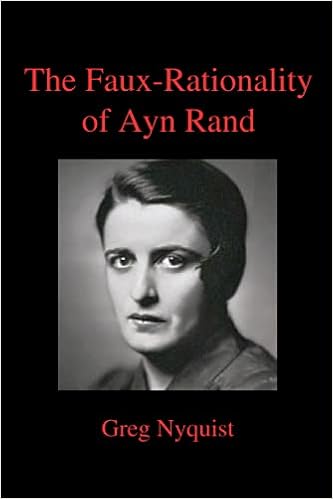
New Book: "The Faux-Rationality of Ayn Rand"


I am pleased to announce the publication of my latest book, The Faux-Rationality of Ayn Rand, which is available at amazon.com in paperback (and hopefully soon in kindle). Whether this is the best critical book on Ayn Rand and her Objectivism philosophy on the market today I will leave to others to decide. But I'd like to think it's the most readable, succinct, and relevant piece of Randian criticism that we've seen to date. It covers the main points of Rand's Objectivist philosophy (i.e., her views on human nature, metaphysics, epistemology, ethics and politics), showing, in lively, pointed language, what is wrong with her various contentions about these domains of experience. It is hardly an exhaustive critique of the Randian sophistry. It doesn't cover everything — only the most important stuff. More than anything else, I see this book as a one-stop shop for discovering what is fundamentally wrong with Rand's philosophy. 

The book is only about sixty-thousand words long and is based on posts published here at ARCHN. The fact is this blog is a bit of a mess. Although most of Rand's philosophy is critiqued in a reasonably systematic matter, it's challenging to read the posts on the blog in the order they were originally meant to be read. The format of the blog simply doesn't allow for that, nor is this something that's easily fixable. Another issue is that many of the posts I contributed to ARCHN were written very hastily and they were not always well proof-read. Much of the material could really use a serious and thorough re-write — but that would be an immense job, and given the slippage of interest in Rand's philosophy, I doubt it would be worth the trouble. So instead I have culled the best and most pertinent posts that I have written for the blog, cleaned them up, arranged them in as systematic a way as possible, and then published them via amazon.com. 


Sunday, March 07, 2021

Peikoff vs. ARI

Documents reveal that Leonard Peikoff, the founder of ARI and the heir to Ayn Rand's literary estate, gave $297 to Donald Trump's Make America Great Committee. The date on the document December 14, 2020, but it's likely the donation was given earlier (almost certainly before the election). Peikoff's generous donation allows us to get a better sense of how much influence he still exerts over ARI.

So how much influence does Peikoff still exert over ARI? Probably very little. Consider Yaron Brook's view of Objectivists who "apologize"  (i.e., support) Trump:

Those of you who are apologists for Donald Trump, please never use the word "Objectivist" to associate it [Objectivism] with yourself. Because you cannot be Objectivists, you are not Objectivists, if you apologize for this guy.

And you are not doing anybody a favor by selling-out, selling-out the fundamental ideas that we believe in. For the sake of what? Popularity, for the sake of defeating the left?

You are sell-outs, you are the fifth-column within Objectivism.

And:

But the Trumpists are a disaster. If they win, and they come to dominate all of the Republican Party and all of its candidates, this country is finished, this country is finished.

Given Brooks uncompromisingly extreme stance against Trump, what are we to make of Peikoff's $297 donation to the Trump campaign? Is Peikoff a "sell-out" and fifth-columnist within Objectivism? How are we ever going to square this particular circle?

Several years ago, when Peikoff was still doing a podcast, he came out in favor of closing the borders. Brooks quickly stepped in to put a stop to this. On Peikoff's next podcast, we hear Brooks explaining why closing the borders is a bad thing to do and Peikoff rather sheepishly admitted he had been led astray by conservative talk radio. 

Flash forward to the last year or so. Peikoff is now in permanent retirement. For health reasons, he can no longer make public appearances. What is he doing with his time? When he feels up to it, he's supposedly writing short stories. What does he do when he's not writing stories? Could he be listening to conservative talk radio? Peikoff has been a fan of Rush Limbaugh at least since the nineties. Is it possible that in his retirement Peikoff is listening more to conservative talk radio hosts (and not just Rush, who recently passed away) than he is to Yaron Brook and other ARI figures? Or has he simply become a fan of Trump on his own unbiased judgment, irrespective of influences? Whatever the case, his $297 donation to the Trump campaign strongly suggests that he does not agree with the folks who have taken over the institute he founded way back in the eighties. It also strongly suggests that Peikoff's influence over ARI has come to an end. I don't know whether Brooks knows (or if knows, whether he cares) that Peikoff has a soft spot for Trump. Whatever the case, it clearly doesn't matter. Peikoff is no longer relevant  in the world of Objectivism.  It's Yaron Brooks and his people who control the institute and who are the big players in that space. They decide what Ayn Rand would have thought if she were still alive.

Friday, January 15, 2021

Anne Heller, as long ago as 2009, published her biography of Ayn Rand. I have finally gotten around to reading it and will at some point make a post or two commenting upon it. In this post I want to turn to another issue --- namely, one of the two organizations tasked with the propagation of Rand's ideas, The Atlas Society. I had not realized the extent to which Heller had used TAS in research for her book. It is notorious that ARI refused Heller access to their archives until long after her book was finished. But it appears Heller didn't need ARI because she had TAS and David Kelley, who explained Rand's philosophy to Heller. It wouldn't be that much of an exaggeration to call Ayn Rand and the World She Made the official Rand biography of the Atlas Society --- although technically that's not true.

Saturday, December 26, 2020

Molyneux and the Objectivist Tradition 6

UPB: Criterion for ethics. Universally preferable behavior, which is the core concept of Molyneux’s ethical speculations, is not an easy theory to wrap one's head around. It is not always clear what Molyneux means by it. Consider the ambiguity which clings to the terms of the following passage:

We all have preferences – from the merely personal (“I like ice cream”) to the socially preferable (“It is good to be on time”) to universal morality (“Thou shalt not murder”).

There is little point writing a book about personal preferences – and we can turn to Ann Landers for a discussion of socially preferable behaviour – here, then, we will focus on the possibility of Universally Preferable Behaviour. (50)

Note how Molyneux goes from “personal” preferences to “social” preferences to “universal morality.” Interpreted in one sense, Molyneux seems to be suggesting a relation between personal and social preferences on one side and “universal morality” (presumably Universally Preferable Behavior) on the other. But this transition is not well explained. It’s as if Molyneux wants us to think of universal morality as a preference, but not a preference in the same way as a sweet tooth for chocolate can be a preference. What precisely is the difference? How does one transition from “I prefer chocolate” to “thou shalt not murder”? How are those two statements both preferences?

Sunday, December 13, 2020

Molyneux and the Objectivist Tradition 5

UPB: The necessary premises of debating, pt. 2. Molyneux argues in his book Universally Preferable Behavior that denying his theory of morality is “innately self-contradictory,” because “saying that there is no such thing as universally preferable behavior is like shouting in someone’s ear that sound does not exist.” Is Molyneux right about this? Is UPB, which Molyneux identifies more broadly with “moral rules,” valid because it is self-contradictory to deny them? Let’s take a closer look at Molyneux’s arguments:  

Tuesday, November 03, 2020

Molyneux and the Objectivist Tradition 4

UPB 4: The necessary premises of debating 1. Molyneux’s sophistry reaches its apex when he commences on the thankless task of “validating” his theory.

“Universally preferable behavior” must be a valid concept,” [insists Molyneux, because] “if I argue against the proposition that universally preferable behavior is valid, I have already shown my preference for truth over falsehood – as well as a preference for correcting those who speak falsely. Saying that there is no such thing as universally preferable behavior is like shouting in someone’s ear that sound does not exist – it is innately self-contradictory. In other words, if there is no such thing as universally preferable behavior, then one should oppose anyone who claims that there is such a thing as universally preferable behavior. However, if one “should” do something, then one has just created universally preferable behavior. Thus universally preferable behavior – or moral rules – must be valid. (35-36)

This is such a mass of confusion and unsubstantiated assertion that it will take a bit of effort to sort all out. I can identify at least three serious problems with Molyneux’s formulations:

Wednesday, July 08, 2020

Molyneux and the Objectivist Tradition 3

UPB 3: Preferences and morality. In his book Universal Preferable Behavior, Molyneux begins his disquisition on ethics by comparing assertions about preferences with assertions about matters of fact. Statements of fact, notes Molyneux are “objective, testable—and binding,” whereas statements of preference are “not generally considering binding … in any way.” Preferences are mere statements “of personal fondness.” It is not incumbent upon anyone to share our preferences. (22)

Monday, June 29, 2020

Molyneux and the Objectivist Tradition 2

UPB 2: Foundationalism and logic. Central to Rand’s philosophy of Objectivism is the largely unsubstantiated assertion that the “objectivity of reality,” along with human knowledge in general, require “validation”; and that in the absence of this validation, human beings become cognitively helpless and hence defenseless against power-lusting authoritarians. Once, however, knowledge is properly “validated,” the masses of people in the civilized world will once again regard their senses, their “reason,” and their minds as reliable guides to reality, which will lead them to embrace “rational” moral and political ideals (i.e., Objectivism).

Sunday, May 10, 2020

Slouching Toward the Next Schism

There are the makings of a potential schism at ARI. Since 1985, Carl Barney, whose made millions in the education industry, was ARI's largest donor. In 2019, Barney left ARI's board and devoted his resources to Craig Biddle's The Objective Standard periodical and to Barney's own Prometheus Foundation. Then, on May 1, 2020, Barney made the following announcement:

“Dr. Peikoff has given me (Prometheus Foundation ...) permission to publicize and deliver worldwide his courses and lectures.”
...
“He has also granted me permission to use his trademark, “Ayn Rand,” as well as excerpts from his and Ayn Rand’s works, which will aid me in marketing. With these assets and my considerable resources, I am eager and ready to ensure that Dr. Peikoff’s courses and lectures reach and continue to reach minds throughout the world. ... 
“I do not intend to start another ARI or to compete with ARI. I don’t intend to establish a new organization of any kind. I intend only to support and fund other organizations and individuals who promote Ayn Rand and advance Objectivism.”
Of course, Barney has to insist he is not competing with ARI; and perhaps his insistence is sincere. But this clearly lays the foundation for trouble in the future. What has happened in the world of orthodox Objectivism is that, with the retirement of Peikoff, there exists no authority figure to adjudicate the inevitable disputes that arise among the Objectivist faithful, particularly among ambitious types jostling for status and influence in the movement itself. Theoretically, these disputes should be adjudicated by "reason." But what goes by "reason" in Objectivism is largely imaginary; and many of the issues which divide people in real life are too complex to be resolved by some "objective" standard of rationality in any case.

Wednesday, April 22, 2020

Molyneux and the Objectivist Tradition 1

UPB: intro. Stefan Molyneux’s theory of Universally Preferable Behavior (i.e., UPB) is an attempt to establish moral principles on the same firm “objectivie” basis as the best theories in science. Essentially Molyneux wants to show how the a moral proposition such as “rape is wrong” can be “verified” in the same way as Einstein’s theory of relativity or the motions of the stars and planets have been “verified” through the scientific method. If he could succeed in this endeavor, Molyneux believes this would demonstrate the objective truth of moral propositions—especially the moral truth of various social and political ideals that Molyneux holds close to his heart, such as the non-aggression principle, “voluntarism” (i.e., anarcho-capitalism) and “peaceful parenting.” Molyneux’s foudationalist mindset is very much in line with what Rand attempted in her own ethical speculations.

In her essay “The Objectivist Ethics,” Rand sought to show how a morality in line with her preferred political system, “laissez-faire” capitalism, could achieve the same level of truth and objectivity that scientifically “verified” theories about the material world enjoy. This ambition to conflate ethical propriety with empirical truth takes even greater importance in Molyneux’s moralistic speculations. In some respects, it is the basis of Molyneux’s whole system. Yet, to be fair, that’s hardly the starting point of UPB.

Sunday, April 05, 2020

The Objectivist "Tradition" Going Forward

Philosophical traditions, like viruses, must mutate if they wish to remain relevant even among their adherents. Orthodox Objectivism has remained steadfastly true to its author's original vision, sedulously resisting the temptation to evolve in ways that would enable it to better fit with emerging paradigms and concerns. The denizens of ARI still hold fast to a hawkish foreign policy in the Middle East, even when most Americans have tired of the endless wars; they still believe in “open borders," even when most people toward the right side of the political spectrum (outside of a few elites) are against them; they are still for absolute “free trade,” even though free trade in both capital goods and the basic necessities of a principality cause harm to millions of Americans and constitutes a threat to national security; they are still somewhat militant in their atheism, despite growing awareness of a meaning crisis among the younger generations; and they remain stubbornly resistant to allying themselves with to their potential allies on the political  the right, preferring instead to retreat into ever increasing ideological and political isolation.

Saturday, March 21, 2020

Objectivism and COVID-19


The COVID-19 pandemic and the response from government presents various challenges to the political ideology of Objectivism, since it presents a crisis that can't be solved merely by letting it alone. In a podcast entitled "Thinking Philosophically About the Pandemic," Onkar Ghate and Gregory Salmieri valiantly attempt to navigate between the dire necessities involved in defending three-hundred and thirty million people from a potentially deadly virus and the imperatives of the "laissez-faire" ideology.

Thursday, July 18, 2019

Objectivism vs. Sam Harris

To say that Sam Harris entertains a low opinion of Ayn Rand and her disciples would be something of an understatement. He once referred to Rand’s philosophy as “basically autism rebranded.” Nonetheless, there are very definite parallels between Harris’s views on religion and morality and Rand’s. Harris and Rand both take a dismissive view of Hume’s is-ought gap; they both believe that science and rationality can determine moral ends; they both are uncompromising critics of religion; they both tend to assume, somewhat naively, that if we could only (per impossible) persuade religious people to dispense with their “superstitious” beliefs and embrace “reason” and science, the world would be a better place; and they both take a dim view of much that passes for academic philosophy.

Despite these parallels in their viewpoints, Objectivists have found plenty in Sam Harris’ moral philosophy to quibble about. Ari Armstrong has been the chief critic of Harris over at The Objective Standard. He makes three main criticisms of Harris’ book The Moral Landscape:

  1. Harris’ concept of well-being lacks the clarity of meaning to sufficiently ground it in a bonafide theory of ethics. 
  2. Lacking a clear conception of well-being, Harris embraces hedonism as the standard of value. 
  3. Harris merges his vague conception of well-being with a form of utilitarianism, which constitutes “a collectivist form of hedonism holding that the good consists of self-sacrificially serving the greatest happiness for the greatest number."

Wednesday, March 13, 2019

The Evolution of Orthodox Objectivism

The Ayn Rand Institute has recently introduced a new set of YouTube videos, many of them hosted by Dave Rubin, called "Objectivism on Happiness." The videos give an insight in how a new generation of "orthodox" Objectivists are framing (or rather re-framing) Rand's ideas. In what I've heard from Yaron Brook, Greg Salmieri, Onkar Ghate, and Tara Smith, there seems to exist a drive to portray Rand's philosophy in such a way that it does not come into conflict with the sciences of human nature. Ayn Rand believed that human beings were, at birth, "blank slates," and that it was through exposure to philosophical premises that they developed personalities and character. The strategy that this new breed of Objectivists appear to have concocted to separate themselves from this embarrassing doctrine is to make it clear that, while they have no intention of explicitly denying the possibility of heritable traits of character, they nevertheless continue to insist that, through the use of "reason" and "free will," they can achieve Rand's vision of the self-created man.

Sunday, January 06, 2019

Did Rand read Kant?

In an interview, Shoshana Milgram, Rand's "official" biographer, is asked whether Rand ever read Kant. Given how far Rand's interpretation of Kant departs from the views of actual followers and admirers of Kant, many people have assumed that Rand must never have read Kant. Objectivists tend to regard this assumption as derogatory of Rand and deplore it. But it's not necessarily any worse than the alternative. For if Rand had in fact read Kant and still gotten him so very wrong, that would speak poorly regarding her ability to interpret philosophical texts. So what is worse? Mis-interpreting Kant because of a lack of familiarity with the relevant texts? Or reading Kant with great attentiveness and still getting him wrong?

Wednesday, October 17, 2018

McCaskey: "Rand doesn’t follow the conventional standards of logic"

John McCaskey, the former ARI board member forced to resign for mild criticisms of a Peikoff protege, wrote in a blog post a few years back about Rand's "method of arguing."

Rand doesn’t follow the conventional standards of logic. She has her own distinctive method of arguing. If that method is valid, her moral and political philosophy stands. If it is invalid, her whole system comes crashing down. 
What is her method and is it valid?... 
Rand’s distinctive method to answering many philosophical questions is to ask what knowledge is already presumed by the very terms in the question. 
You say, “Miss Rand, I want to argue with you about the proper role of government.” She replies, in effect, “OK, but let us first unpack the concepts you are using. What are you already assuming by using the words ‘proper’ and ‘government’?” If you think of a government as the owner of buildings where you fill out forms and “proper” as whatever avoids your mother’s wrath, then Rand will insist that the two of you first work out a mature and essentialized understanding of these concepts.

In other words, Rand seeks to answer very complex philosophical questions via an explication of the meanings of words. Is this an effective way to answer moral questions? Is it an effective way to determine matters of fact?


Monday, July 23, 2018

What was Ayn Rand Wrong About?

What follows is my answer to a question posed on Quora: What was Ayn Rand Wrong About?
On the technical side of things, Rand was wrong about (1) the need to validate man’s knowledge—i.e., foundationalism; (2) that concepts require definitions and that definitions can be true or false; (3) that emotions are automatic effects of man’s value premises; (4) that abstract philosophy determines the course of history; (5) and that emotions are not “tools of cognition.” If we wished to really get into the philosophical weeds, we could probably ferret out even more technical errors, but beyond a few hard-core Rand acolytes, I doubt that anyone really cares about any of these largely technical issues. Nowadays Rand is mostly known for her zealous affirmations of egoism, “selfishness,” and laissez-faire capitalism, and her concomitant denunciations of altruism and all forms of government interventionism. Perhaps her most influential contention is that freedom and capitalism require a moral foundation, by which she meant: convincing philosophical arguments on their behalf. This conviction is based, however, on faulty assumptions about moral philosophy, human reason and psychological motivation.

Monday, July 02, 2018

Peterson at OCON: A Quick and Dirty Review

Those of us who are cognizant of orthodox Objectivists at their worst knew that the discussion/debate with Jordan Peterson that was held at OCON could have ended very badly for the Randian cause. Luckily for the denizens of ARI, Brook and Salmieri managed to escape any serious mishaps. They wisely avoided challenging Peterson on issues relating to psychological science and tried to keep to discussion restricted to areas where they thought they had an advantage. Consequently Peterson delivered no Cathy Newman killshots (not that he wanted to) and Brook and Salmieri escaped relatively unscathed. While that's a kind of a win for Brook, on the other side of the coin, I don't believe things ended quite the way Brook had hoped. It appeared to me that Brook and Salmieri were using different strategies. One of the great weaknesses of orthodox Objectivism is that they have trouble understanding non-Objectivist thinkers. They are more interested in refuting and/or condemning people with different views than understanding them. This approach to their adversaries caused Brook to adopt a strategy that wound up backfiring. Brook seems to have gone into the debate under the illusion that Peterson is an opponent of metaphysical realism). At one point in the discussion, Brook waxed on about the independent existence of his water bottle, only to be stymied when Peterson kept agreeing with him.

Friday, June 22, 2018

Jordan Peterson is going to OCON

Yaron Brook has announced that Jordan Peterson will involved in a debate/discussion entitled "Philosophy and Man's Soul" at an Objectivist conference (i.e., OCON) on July 1. Peterson will be joined by Yaron Brook, Onkar Ghate, Greg Salmieri and Dave Rubin. The event will be live-streamed on The Rubin Report:


Thursday, June 07, 2018

Objectivism: an Autopsy, Part 4

In Nathaniel Branden's essay "The Benefits and Hazards of Objectivism" we come across the following observation:

The great, glaring gap in just about all ethical systems of which I have knowledge, even when many of the particular values and virtues they advocate may be laudable, is the absence of a technology to assist people in getting there, an effective means for acquiring these values and virtues, a realistic path people can follow. That is the great missing step in most religions and philosophies. 
You can tell people that it's a virtue to be rational, productive, or just, but, if they have not already arrived at that stage of awareness and development on their own, objectivism does not tell them how to get there. It does tell you you're rotten if you fail to get there.

Rand's failure to provide a "technology" for attaining Objectivist moral values is not her only failure in this regard. She provided very little in terms of achieving any of the things she regarded as desirable, whether it was rationality, persuasion, or laissez-faire capitalism. And on few occasions where she provided at least the outlines of a technology (as in aesthetics and "philosophical-detection"), what she actually gives us is deeply flawed. Hence the ironic spectacle of Rand followers who don't know how to be rational, Objectivists who don't know how to solve moral conflicts with other Objectivists, and the lack of a strong, vibrant Objectivist artistic movement.

Friday, January 05, 2018

Objectivism: An Autopsy, Part 3

In some respects, Rand's ideology of Objectivism can be seen as an over-reaction to the Marxist left. Rand lived through the Russian Revolution and experienced communism first hand. She despised the Marxian creed with every fiber of her being, and in her philosophy of Objectivism she sought to fashion a doctrine diametrically opposed to the collectivist and anti-capitalist dogmas of Soviet communism. Thus Rand wound up advocating a pure (some might say "extreme") form of individualism and capitalism as a way to oppose the murderous collectivism of Marxist-Leninism.

Rand began formulating these doctrines more than seventy years ago. The ideological landscape has undergone significant changes during this time. After the publication of Alexander Solzhenitsyn's Gulag Archepelago, the Soviet version of Marxism became thoroughly discredited in the West, even among radical leftists. But the pathological urge to impose equity fairness on modern society has persisted among our civilizations' left-leaning discontents. To scratch the equity fairness itch, a new type of Marxism needed to be formulated. Thus was born Post-Modernism and Identity Politics, which replaced the class conflict paradigm of the old Marxism with a new paradigm based on race, gender, and sexual orientation. This constituted a real improvement over traditional Marxism in that it justified and nurtured a powerful political coalition between white progressives and non-whites. Demographic changes caused by declining birth rates among whites and increased immigration of non-whites will increase the chances that the left, and quite possibly the radical left, enjoys a permanent electoral majority in the United States in future decades.

Monday, July 24, 2017

Orthodox Objectivism: An Autopsy, Part 2


Orthodox Objectivism may have been doomed from the start, simply because it was a dogmatic philosophy that prided itself on rationality and self-interest yet which, in its specific doctrines and in the behavior of its adherents, often betrayed these stated objectives. Rand's contention that human beings are born "blank slates" is about as rational as the belief that the earth is flat. And as for self-interest: is it really in anyone's self-interest to embrace orthodox Objectivism? Doubts persist on this score. Some years ago Barbara Branden noted that far too many Objectivists came off as bitter and angry. Is it really in your self-interest to be angry all the time? Is it really in your self-interest to continually distort and/or misunderstand the views of people you disagree with, while at the same time being hyper-sensitive to alleged distortions of your own views? Is it really in your self-interest to remain an adherent of a philosophy which has no viable track record of making its adherents smarter, wiser, happier, or more fulfilled? Orthodox Objectivism had so much going against it right from the start. But the dim prospects of the philosophy were made many times worse by Rand's choice for the heir to her literary estate, namely, Dr. Leonard Peikoff.

Tuesday, May 23, 2017

Brief Re-visitation of Is-Ought Problem

Below is a response to an email request concerning an answer to Patrick Neil's essay on Rand's morality:

 Neil's article refutes the view expounded in Rand's article "Objectivist Ethics." In that article, Rand attempted to refute the is-ought gap by claiming that Hume denies that morality has anything to do with facts. This is just wrong. In a later article, Rand pursued a different tactic. She suggested that ethics is conditional on choosing life. Now logically this does allow Rand to skirt around Hume's is-ought gap, because instead of reasoning from "is" premises to an "ought" conclusion, the line of reasoning goes, "if x, then y," or: "if life, then the ultimate value is life."

While this mode of procedure may solve, or at least mitigate, the logical problem presented by the is-ought gap, it is questionable that it provides an "objective" code of values. The argument is so vague and abstract that it's difficult to logically generate a specific moral code that can guide everyday decisions. How does saying that life is the ultimate value help a person choose their career, or their life-mate, or how to spend their free time? Well, it doesn't help with any of these things. It's not even clear what it means, in terms of practical decision making. If life is the ultimate value, does that mean you should act to survive as long as possible? But that's not the principle Objectivists follow in their own decision making. Objectivists make use of the argument to "prove" the objectivity of their morality. Then they ignore the argument and follow their natural hard-wired and socially fine-tuned proclivities like everyone else. As a point of fact, human beings don't follow articulated moral systems derived from abstract philosophical reasoning. Everyday decision-making involves too much complexity for articulated systems of morality to work and be effective. Our brains have evolved complex motivational systems that help us survive and breed. These systems are hardly perfect and can perhaps be improved here or there through conscious reasoning (although that's not always the case), but it's impossible to entirely replace them with a "code of morality" based on a philosophical system of ethics like Objectivism. The Objectivist Ethics is little more than an ex post facto rationalization scheme to justify behavior Rand and her followers approve of and to provide a moral rationalization for the Objectivist politics. It doesn't provide a guide for how people should behave; it provides tools to rationalize types of behavior approved of by the broader Objectivist community.

For info (and scientific evidence) on how morality works in the real world of fact, see James Q. Wilson's The Moral Sense, Jonathan Haidt's The Righteous Mind, and/or Jordan Peterson's YouTube lectures on "Personality" and "Maps of Meaning."

Friday, March 10, 2017

Orthodox Objectivism: an Autopsy, Part 1

While it may be an exaggeration to say that orthodox Objectivism, since ARI continues to exists and apologists for that organization still exist. But as an intellectual force, it is dead --- and probably not revivable. Some might argue it's been dead, or close to death, for several decades. But there was always a hope, however dim and unlikely, that the corpse might be resusitated. Indeed, in 2008, orthodox Objectivism showed a brief flicker of life. Sales of Atlas Shrugged surged, and Rand once again became a favorite target of the left. But in the end, nothing came of it. In 2010, Leonard Peikoff conspired with ARI executive director Yaron Brook to force John McCaskey, a lucrative donor, to resign from the ARI board of directors for the sin of challenging then Peikoff protege, David Harriman. In retrospect, that unsavory episode appears to have been orthodox Objectivism's last gasp. While ARI will undoubtedly persist for many decades to come, perhaps even longer, in terms of intellectual significance, it's impact on the culture will be so close to zero that it might as well be zero.

Thursday, February 02, 2017

Haidt versus Rand

Social psychologist Jonathan Haidt is a leading researcher and writer on what could be described as the scientific view of human nature --- a view, in other words, based on research and experimentation rather than armchair speculation and/or wishful thinking. If Haidt's views on human psychology, motivation, reason and morality are largely right, than Rand's views must be largely wrong. As it turns out, Rand's epistemological, moral, and political views all rest, at least in part, on her views on human nature; so that if she's wrong about human nature, she must also be wrong, at least in part, on human knowledge, ethics, and political theory.

Recently Sam Harris made a curious wager. He offered to pay $10,000 to anyone who could disprove his arguments about morality. Haidt decided to make a counter-wager. He bet $10,000 that Harris would not change his mind. And then he went on to explain why he made the bet. What Haidt wrote provides an excellent brief on what is wrong with the view of reason and morality which both Harris and Rand share.